
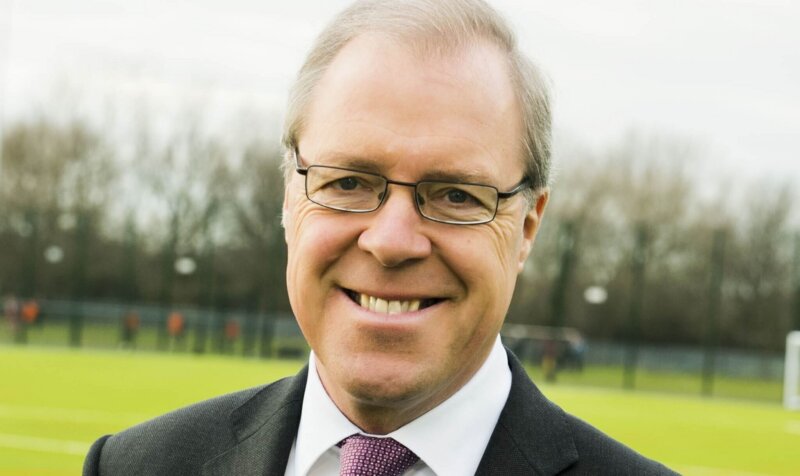
After 38 years at the charity, of which 20 were spent as Chief Executive, Alex Welsh will be retiring from his role in March 2027.
Having been recruited as Centre Manager of the country’s first dedicated regional football centre at Douglas Eyre Sports Centre in 1989, Alex was given a remit to widen and increase usage at the ground. With a background in professional football, coaching and education, he had a clear vision for using sports development principles to create better school-club links. In addition to ensuring that usage of the centre spanned the gamut from schools’ football to professional level (including providing a training base for Leyton Orient) he also brought hockey to the venue and delivered a long-running school based coaching scheme via a partnership with Arsenal Football in the Community. As part-time FA County Coaching Representative for London FA, Alex set about making Douglas Eyre Sports Centre a major venue for coach education.
In 1991 he also masterminded the delivery of the NCF’s Champion Coaching Scheme covering nine sports across secondary schools in Waltham Forest and Hackney. In 1993 LPFF won the Champion Coaching Scheme of the Year which was quite an achievement considering it was the only charity out of 65 local authority projects.
It was at this time that the Foundation realised that sport could have an impact well beyond the pitch and Alex designed and delivered the Police Coaching in Primary School which was designed to foster harmonious relationships between local youngsters and the home beat officers. The project proved so successful that The FA arranged for it to be promoted in other parts of the country.
In 1991 following the abolition of ILEA, the charity acquired Wadham Lodge Sports Centre in Walthamstow and Alex was made manager. His vision was to transform the ground into a regional centre for cricket development. Alex met with sporting stakeholders and council officers to garner their support for the development and submitted the funding application to the Sports Lottery which, with a significant contribution from the Peter May Appeal, led to the opening of the £5million Peter May Sports Centre in 2000. As Operations Director, over the next three years he oversaw the redevelopment of the pavilion at Fairlop Oak Playing Field (with Powerleague as a commercial partner) and the acquisition of London Marathon Playing Field Greenwich, with the aim of making both grounds more accessible to youth and women. The charity subsequently acquired two more grounds in Redbridge in 2000 and Ealing in 2007.
His ethos of building strong relationships with the schools, clubs and community organisations using LPFF grounds as the fusing force, has been key to ensuring that the charity meets their needs and in return maintains high pitch utilisation rates. As someone with a clear passion for coaching, it is no surprise that he has also championed the use of LPFF’s grounds by FA and PFA for coach education courses.
As a strong believer in playing fields being more than just open spaces, and places where the power of sport can be used to tackle inequalities, bring communities together and to improve lives, Alex developed a series of social inclusion projects targeting hard to reach groups. The All Nations Football Festival launched in 2001 in partnership with Refugee Council helped to assimilate young male refugees fleeing civil war into London life via having access to mainstream football. Projects such as Active Angels and Girls’ Football Hub encouraged girls and women to become more physically active and Female Coach Development supported women to progress on their coaching journey. By far the longest running project and the one providing the biggest impact has been Coping Through Football. In 2005 Alex devised a project to reduce suicide as the biggest cause of death amongst 18-35 year old men. Working in partnership with NELFT and Leyton Orient Trust, the charity established a ground-breaking project for men (and later women and young people) which used football as a tool for engagement and as a means of helping people experiencing serious mental health problems to get their lives back on track. The impact of the project has been incredible, with some participants stating that it has saved their lives. Now in its twentieth year, it is testament to Alex’s energy and perseverance that the project continues to be underpinned by clinical foundations and is recognised by funders as providing such a vital service to a vulnerable group of people.
Once in post as Chief Executive in 2007, it was clear to Alex that the charity needed to find new sources of funding as the grants available for such revenue projects had begun to dwindle. This led to the establishment in 2011 of an annual fundraising Gala Dinner and subsequently a Sports Quiz and Golf Day. The events, held at prestigious venues, helped to raise the charity’s profile and introduce it to new audiences. The Gala Dinner alone has raised over £2.2milion over a 15 year period transforming the charity’s finances in the process.
Running parallel to its sports development work, Alex recognised early on the need for the Foundation to play a leading role in the protection of playing fields in London and to work hand in hand with Sport England to provide that first line of defence against the cycle of playing field decay and their eventual loss. In 2026 this support culminated in the Foundation successfully lobbying Government to withdraw its proposal to end Sport England’s statutory consultee status.
Away from his LPFF work, Alex spent 33 years as a coach at the Arsenal and Tottenham Hotspur Academies and as a Lead Tutor for The FA’s Coach education programme. In addition to being a member of the London Sports Board, he was also Chair of the Association for Sports Development in London, London Active Partnerships, the Greater London Local Football Partnership, the South London Special League and the London Football Coaches Association. He is the author of two books on goalkeeping. In 2012 he was presented with the Proactive London Sports Partnerships Lifetime Achievement Award.
In reviewing his time spent at the charity, Alex states that his proudest achievement was the recruitment of staff and Trustees, all of whom had demonstrated unwavering loyalty and produced work of the highest quality. LPFF Chairman William Cadogan expressed his sadness at Alex’s announcement and thanked him for his incredible length of service and immeasurable contribution to the charity’s work.
